

How long does it take to recover from a dislocated shoulder?
by Margie Olds
Recovery time after a shoulder dislocation depends on the damage caused by the injury. If the damage is limited, some people may return to sport within a few weeks. More significant injuries can take much longer and may need additional treatment.
Safety note: Return to sport should be guided by a qualified healthcare professional. Do not return while you have pain, restricted movement or reduced strength.
What affects recovery time?
Recovery depends on the amount of tissue damage, whether the shoulder has dislocated before, the direction of the dislocation, and how consistently rehabilitation progresses. Surgery, a fracture, damage to the labrum or ongoing instability can also change the timeline.
To learn more about the damage that can occur after a shoulder dislocation, read our guide to shoulder dislocation pathology.
A typical recovery pathway
1. Assessment and protection
Early care focuses on confirming the direction and severity of the injury, managing pain and swelling, and protecting the shoulder while the irritated tissues settle. Follow the plan provided by your healthcare professional rather than using a calendar date to decide when to increase activity.
2. Restoring movement and control
Once it is appropriate to progress, rehabilitation usually focuses on gradually restoring comfortable range of movement, then rebuilding rotator cuff and scapular strength. Your programme may also address coordination, confidence and the positions that make your shoulder feel unstable.
3. Returning to activity
Returning to sport is usually a gradual process rather than a single decision. Before progressing, you should be able to move the shoulder comfortably, use it with appropriate strength and control, and complete sport-specific activities without pain or a sense of slipping. Your healthcare professional can help decide when you are ready.
If pain, weakness, restricted movement, repeated slipping or apprehension continues, arrange a review rather than pushing through it.
Keep learning
For a step-by-step look at rehabilitation, read Phases of rehabilitation after shoulder dislocation. If you are concerned about ongoing instability after an injury, you can also read Predicting recurrent shoulder instability.
Want a clearer recovery plan?
Get the shoulder rehab ebookAnterior shoulder dislocation
An anterior shoulder dislocation is the most common type of dislocation during sport. It happens when the upper arm bone moves forwards and out of the front of the shoulder. This often occurs when the arm is away from the body and the hand is rotated upwards, causing the shoulder to over-rotate or stretch backwards.

If your healthcare professional recommends shoulder support during a return to activity, an anterior shoulder brace may help limit movement into vulnerable positions. Suitability depends on the injury and should be discussed with your healthcare professional.
Posterior shoulder dislocation
A posterior shoulder dislocation happens when the upper arm bone moves backwards out of the shoulder joint. It can occur when someone falls forwards and puts an arm out to stop the fall. If the arm is across the body and the hand is rotated inwards, force can be directed towards the back of the shoulder.
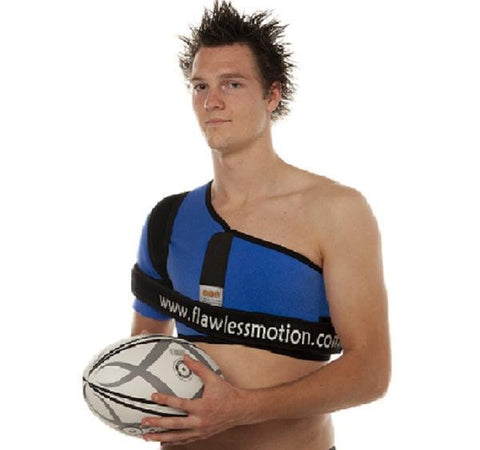
Posterior dislocations are less common and may involve more force than anterior dislocations. If support is appropriate for your recovery, a multi-directional shoulder brace can be configured to support the back of the shoulder and help limit movement.
Watch: returning to sport after a shoulder dislocation

Dr Margie Olds is an internationally recognised physiotherapist with a special interest in shoulder injuries. She developed the Flawless Motion braces to help people return to sport as safely as possible. Her PhD explored the factors that can predict recurrent shoulder dislocation after injury. To learn more about her research, read the research overview.


